LOL -- EMDASH -- IM FIRED :( CAN U SPARE $750B?

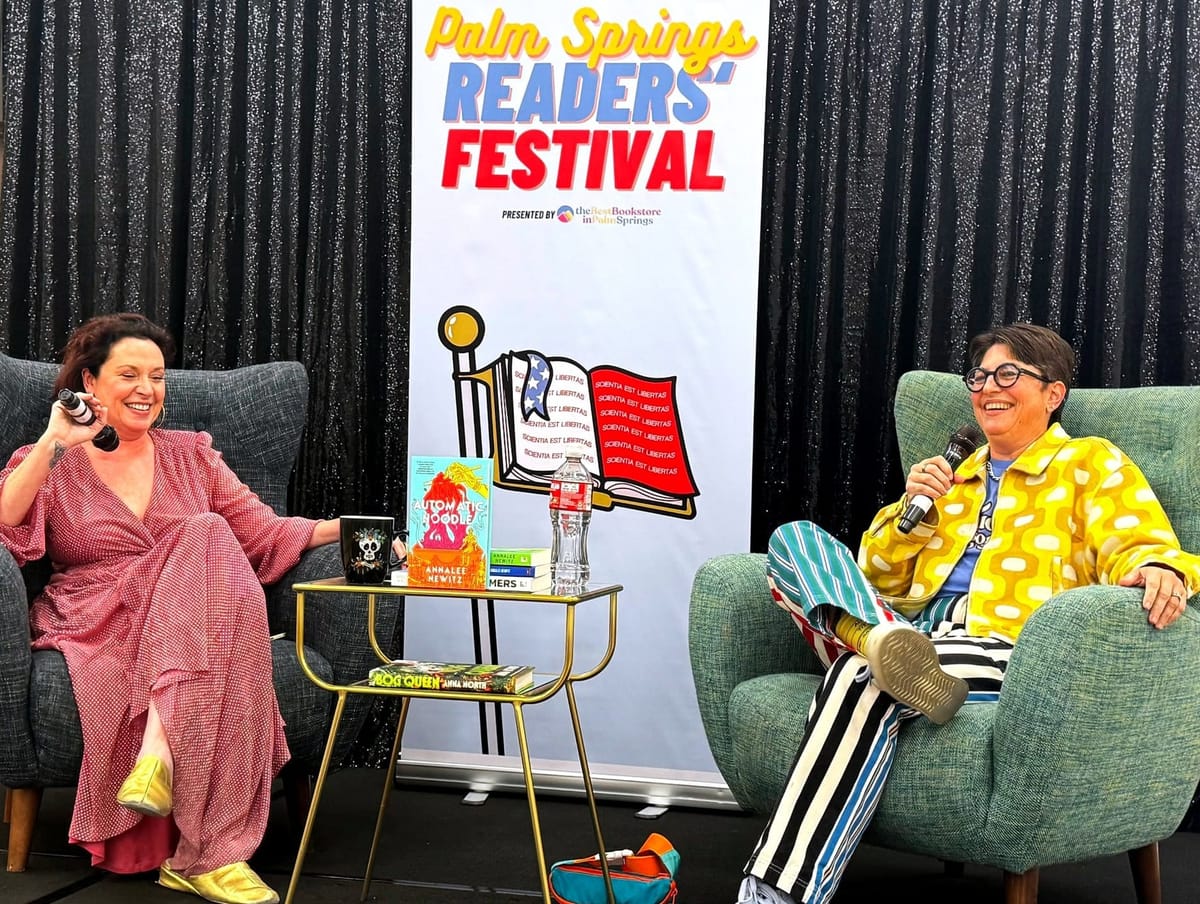
Last week, our store(s) hosted our third annual Palm Springs Readers’ Festival. It was an absolute smash. More attendees than ever, 20% more book sales, and it was profitable for the first time ever.
These events are a far cry from the glitzy million dollar conferences TechCrunch and Pando used to put on where I got to be talent, and we had six figure sponsors. (Hilarious to think about.)
Paul, one part-time staffer, our teens, and I were the only staff. We did interviewing, AV, checking people in, arranging travel, booking talent, GETTING LUNCH FOR ALL ATTENDEES, plus coffee and doughnuts, carrying hundreds of boxes of books to so many places. Every grubby job.
But also interviewing so many incredible authors and getting to host them in one of the best places to ever be in February for three days. The best part of this festival is getting to know 18 or so authors really well each year. And being "forced" to read about 20 books each January.
I could go on and on about each speaker.
But there was one moment I found so profound that has resonated for me since. . .
Annalee Newitz is a nonfiction techwriter and sci-fi author whose “Automatic Noodle” has been a runaway hit on its sixth printing. (We could barely get copies.) They’re an interesting person who writes about tech in the most adoring way.
Automatic Noodle is the story of the robots who make noodles for people in San Francisco in a post-war world and suffer against robot-phobic humans who try to review bomb them out of existence. You adore these damn robots. And yet, they told us we had to reimburse them for travel in cash because they hated all of the payment platforms.
“Do you like technology or hate it?” I asked. And the question was essentially, “I love technology. I hate what a lot of companies do with it.”
Well, I think a lot of us can agree with that, and I appreciate someone still having the nuance to separate the two vs just TECH GOOD or TECH BAD.
As an author and technologist, Annalee had a similarly sophisticated view of AI. They've been writing about the imminent coming and promise of AI for decades. And as they noted, in each wave, it was over sold and overhyped. But they said what so many of us are now thinking outloud: It is also overhyped now.
They continued (and I’m paraphrasing and was on stage, so hopefully I get their gist accurately): The companies behind this so badly need us to all use this stuff, they keep shoving it in every product and forcing it on us. But it’s not really that useful, and most of us don’t really want to start using it. Unlike other changes in work, like when we went from documents to computing or offline to online, where it was a pain in the a**, but yeah, we could see the value of it. The value is just not there. But they need it to be there.
I could not agree more.
I think for some vertical and invisible use cases, AI is tremendously powerful. I spend a lot of time in the VC space and I'm fascinated by Boardy. I consult with a startup called Decile Group that uses a lot of AI in its VC admin product and it statistically moves the needle on how quickly new managers can close funds. That's not what I'm talking about.
I am talking about where it shows up for me as a free mass market consumer product and is abjectly forced on me. In Google, LinkedIn, Facebook, Apple products etc. It is irritating, intrusive, and clownishly terrible. (This will get to writing, I promise.)
When Gmail FORCES its version of emails I might write they are laughably off base and facile. Same with LinkedIn replies. And what’s worse: They aren’t saving me anytime. They are costing me the time to erase the autofilled nonsense and then research how to go into my settings and turn it off.
Even if it was right, I don’t need AI to write, “Sounds good, see you at noon.” That takes me two seconds. Don’t waste water on that. I do not want you in my emails writing for me. It's creepy and obnoxious for no value add. There are a lot of things I frankly let Google do that are also creepy and obnoxious. We all do with all these companies. But we do it because there is a value add. They've missed the mark here again and again.
Likewise, Apple’s autocorrect has gotten offensively bad of late. And I don’t know if you’ve had a major airline cancel a flight and reroute you of late. But if the route only works if you can fold a map in half stab a pencil through it and and connect two cities in a non-space-time way, it's not a sensible route that works in the real world. Once again: Time wasted, not saved. Get out, AI. Get out.
Again: I’m not saying AI isn’t a whole new step function of blah blah blah yeah I get it. I’m not saying some of the coding abilities aren’t impressive, that you can't build things in a second and all that. that many of the vertical applications and no doubt commercial applications that a layperson doesn’t see aren’t transformational.
But the idea that right now OpenAI is worth near a $1 trillion for what it gives the world is. . . hilarious. Amazon is worth $2t. Google is worth $3t. Only a handful of companies are worth over $1t. And only recently were any companies worth that much. And OpenAI– while impressive, sure– doesn’t do anywhere near what those companies do for a comparable percentage of humanity. Most of us could walk away and be fine.
I also don’t have a dog in this fight. I’m not a VC or a reporter. If you’d all like to spend that much on OpenAI shares, have fun. There are worse things happening in the world at the moment.
Here’s what I do know, and I’ve long had confidence in: My job is not in danger. Because this sh*t cannot write. It can barely write an email. It can barely write a good social media post without being edited. It’s not going to be able to collaboratively write a book. Not now. Maybe not ever.
Because even if it could skill-wise (doubtful), so much of my job is being honest with people. And AI is sycophantic to a fault. One of the reasons I am paid what I am paid is because people trust me to be honest with them.
There’s also the problem with hallucinations. Some of the best business books – yes even business books– have weird, off the wall, vulnerable, super human aspects to them. Either those come from the authors or sometimes they are my ideas or a combo of us talking and collaborating. But those unique risks are what make them break through the noise. AI can’t distinguish what is unique and creative and a risk in a good way from a batsh*t hallucination. (Hell, sometimes agents and editors can't either. Which is why sometimes a self-published book is the breakout.)
I realize this sounds self-serving. And like OpenAI’s valuation: You can agree or not. My time is fully booked with amazing projects until at least June, and three of my authors’ books went to auction last year so I’m good either way. The great thing about being a collaborative writer is I don’t have to be for everyone.
But here’s the wild part: AI companies essentially agree.
The great Lesley Gold – PR and story telling guru– sent me this yesterday: According to Business Insider, "the hottest job in tech right now is WRITING WORDS."
Subhead: “The rise of slopaganda is fueling a surprising tech hiring boom.” Apparently you can’t “vibe code” your way out of a story paper bag.
From the piece:
“Andreessen Horowitz launched its New Media team last year to help founders learn what they ‘need to win the narrative battle online.’ Adobe is looking for an ‘AI evangelist’ to lead the company's ‘artificial intelligence storytelling.’ Netflix, a company that sells stories to your living room, recently posted a director of product and technology communications role with a salary range of up to $775,000. Microsoft began publishing a print magazine, Signal, last year, calling it an ‘antidote to the ephemeral nature of digital.’ Anthropic tripled the size of its communications team last year, growing to about 80 people and is still hiring five more, each offering salaries of around $200,000 or higher. OpenAI has several open communications jobs boasting salary listings of more than $400,000. The average director of communications in the US makes $106,000, according to Indeed.”
Yep. The very companies shoving these tools into our products telling us how much we need AI to write our emails and social media posts, text messages. The most basic things we write that don't even need punctuation, are double, triple, quadruple, or seven-fold paying the national average for communications professionals. This as they do massive, record-setting layoffs elsewhere throughout organizations.
Wait a minute. . . can’t Gemini et all just help them write all that?
I have never once subscribed to Business Insider. But you better believe I paid $49 to read more.
GO ON Amanda Hoover. . .
You remember when the marketing department got a male, extra-zero, glow up when we called it growth marketing or performance marketing or the extra testosterone version growth hacking?
Now we are calling writers, editors, and chief comms people who work closely with CEOs, “storytellers,” according to BI. And the Journal reports the percentage of posting on LI mentioning that word doubled from 2024 to 2025, per the article.
I mean, kudos for keeping it a word that most people consider a feminine skill and not making it all Redbull or macho. Like STORYFACEHACKERSMASHER. STORYSHOVER. GROWTHTRUTHER. EVANGELISMNINJA. (Ok, given the growth in actual MAGA and religious Evangelists in Silicon Valley the latter two could have gotten confusing.)
Sadly, I paid $49 and got an extra paragraph only with that story. That was pretty much it. Still worth it to have a link I can STORYSHOVERGROWTHTRUTHEREVANGELISMNINJA into everyone’s DMs everytime they pretend AI can write. Because even the platforms whose valuations depend on it, are paying up to seven times the industry average because they don’t think it can.
Despite being paid less (per client) than someone deflecting from the Queer Eye drama or defending OpenAi's valuation, I’d never up my rates, because I love the people I work with and I intentionally don’t work with the people who can pay me the most. But clearly, I could. Clearly it is a sellers' market for those of us who got liberal arts degrees when everyone else was told to go into tech.
Good story telling isn’t becoming commodified, it’s becoming endangered. Because it's so uniquely human. Has been since the cavemen days when it kept us alive.
And if that’s the case for a company’s media story– it’s really the case for something the length of a book.