How Did the WaPo Get Writers and AI SO WRONG? (Again?)
I suppose this should not be a shock for a publication that recently killed its book section, despite both print book sales and indie bookstores surging. But WaPo seems to have– again– fundamentally misunderstand the value of books, authors, and writing.

I suppose this should not be a shock for a publication that recently killed its book section, despite both print book sales and indie bookstores surging. But WaPo seems to have– again– fundamentally misunderstand the value of books, authors, and writing.
The WaPo has a fancy graphic today showing which jobs are most threatened by AI (and points out that the ones most threatened are disproportionately held by women.)
The article is a nice idea ,and I'm sure a lot of great data science and research went into it. I wonder though. . . I just wonder. Did AI do this research? Because it seems to lack a lot of human gut check logic.
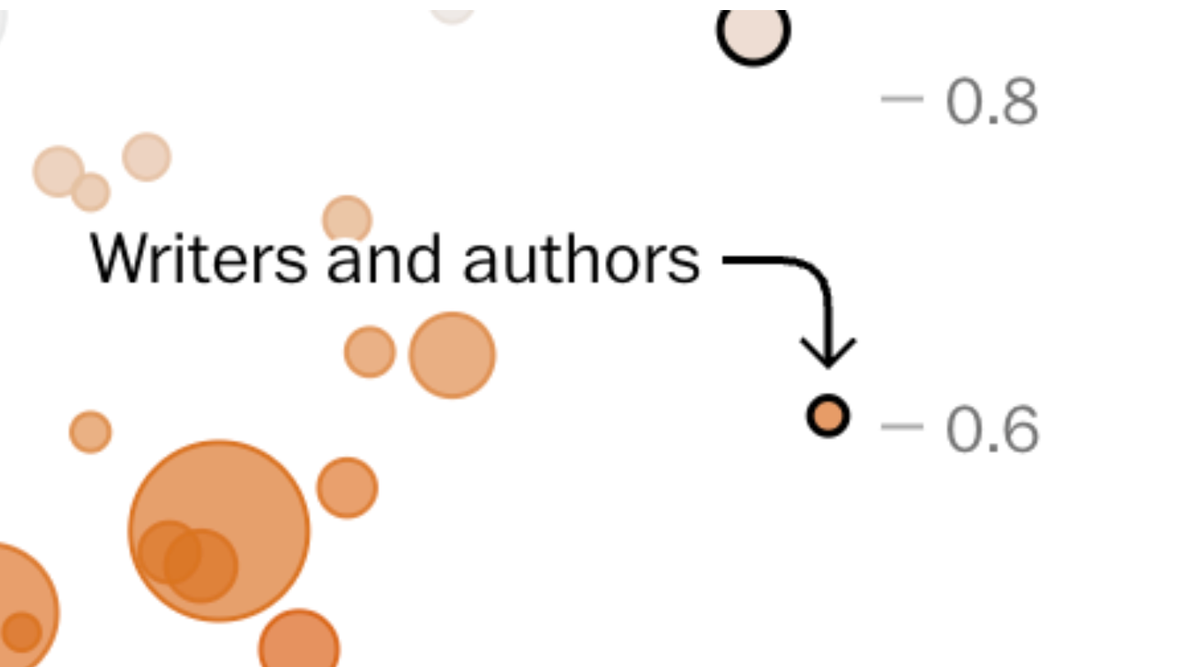
I didn't interrogate every dot. But it claims writers and authors are substantially more f'd than web designers, for one. We are waaaaaaaay far out there-- like Pluto in the solar system -- when it comes to the most exposed to AI's ravages, along with Web designers.
But, unlike web designers, we are considered unadaptable.
FWIW, secretaries get it worse than us in this chart. While all three professions are considered "at risk" secretaries are the inverse of web designers when it comes to "adaptability."
Whoever wrote this has never seen what a highly paid EA goes through, versus a highly paid web designer, point one.
But soft skills (or rather, survival skills) like "adaptability" aside, I'm unclear of the logic here. What I'm hearing is that many of the low level web design jobs will be replaced; but we'll need a new, higher level layer to manage those AI agents. OK.
How does the same analogy not hold true for secretaries as for web design? I imagine booking flights, scheduling meetings will be done by AI OK. And we don't think there will need to be a human layer on top?
It strikes me the core work of being a secretary is even more of a human skillset that cannot be replaced by machines. Marc Andreessen, for one, has had the same EA for decades. I assure you, AI will not be replacing her. Anyone who can now afford a secretary will still want a human being making sure his or her schedule hasn't been slopped.
Perhaps whoever wrote this maybe thought being a secretary wasn't as specialized a skill set? I find it interesting that the piece had the gender awareness to note that the jobs most at risk were ones dominated by women. However, at the same time, it seems to have placed less value on the some of the underlying skills, importance and adaptability of those jobs that are considered predominately female.
But let's get back to writers and authors, where I have a bit more expertise.
On paper (or screen), it makes sense that writers and authors are at risk. I mean: These core systems were all built by stealing our work. And there are definitely some writing jobs that will be gone (same as every profession; that's why we needed this big chart.)
But a few points:
1) The writing is sh*t now. And the coding isn't. Even for press releases at this point. People firing entry level writers are either having to ask other people in organizations to do editing and rewriting or are regretting firing the writers.
People who have fired writers and are bragging about AI doing the work remind me of Troy McClure juicing an orange.

2) If it becomes less sh*t still won't have human experience behind it. That's what makes writing, writing. Especially when it comes to books. No one can read 300 pages if they don't like you. AI is sycophantic. It isn't likable. Even if AI cracks a human voice, it sustaining readability for 300 pages is another matter.
Let me give you an example. My partner Paul Bradley Carr is one of the best writers I know. He almost sold his first novel on a partial-- almost impossible. Ultimately, the big five publisher in question said no.
Why? Because while the dialog was incredible, it was ultimately like an unending scene. Like sitting in a three minute comedy set for 100 pages. It was exhausting.
So Paul had to throw it away and go train with a human-- Lisa Cron-- for more than a year to learn how to craft a novel. He had to spend endless-- and I mean ENDLESS -- hours talking to his human partner (me) about it. And asking other friends to read it. And staring into his own human abyss of experience and fear and doubt.
And this is someone who had already published multiple non-fiction books and written professionally every day of his adult life. AI could not have consumed all of Paul's work and written a novel without human intervention if the actual Paul could not have.
Anyone who doesn't get this, doesn't know what books are.
3) And even IF it did that, it's the idea of connecting with another person that readers love. When people come in our stores-- no matter who they are; no matter what demographic-- and they see a book they love , they all do the same thing. They pick it up and hold it to their hearts. Books are a heart to heart connection, because a part of someone's soul has to go in that book for it to work. For you to want to spend 300 pages in it.
The strange thing is: This chart acknowledges there are things AI can't do. It's sad and embarrassing it doesn't think that's one of them.
4) Here's how you know this graph has completely missed the mark, even if you disagree with all of the above: It says writers and authors are not only in the "most exposed" category, they are also in the "least adaptable" category.
HAHAHAHAHAHHAHAHAHAHAHHAHAHA. ha.
Point 4.1: You realize that TS Eliot worked as a banker his whole life right? Most great writers have other day jobs, because being an author wasn't exactly a lucrative "slam dunk" like say. . uh... coding. If anyone knows how to cockroach-like survive in order to put words on a page long enough to make it, it's writers and authors, friend.
In fact, advances against royalties really only became a standard for commercial authors in the 1950s thanks to the rise of literary agents. (Thank you agents!) And about 6% of book proposals will get any deal. Let alone a sized deal that pays the rent or supports a family.
At least when actors make it big, they make it BIG. Paul and I have noticed that no matter how big the author, every single one has always been so grounded and kind (with the exception of one, who ironically wasn't a big name, and whose spouse had to be banned from our PS store!).
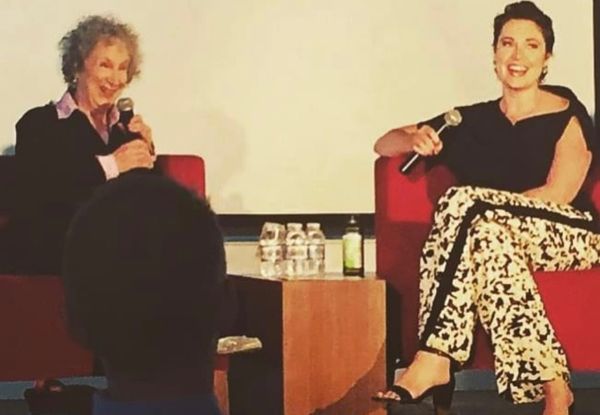
Margaret Atwood spoke at a Chicago event of ours-- unpaid. Carried her own luggage, showed up in a taxi she hailed at the airport, and almost missed her flight because she insisted on signing every book before she left.
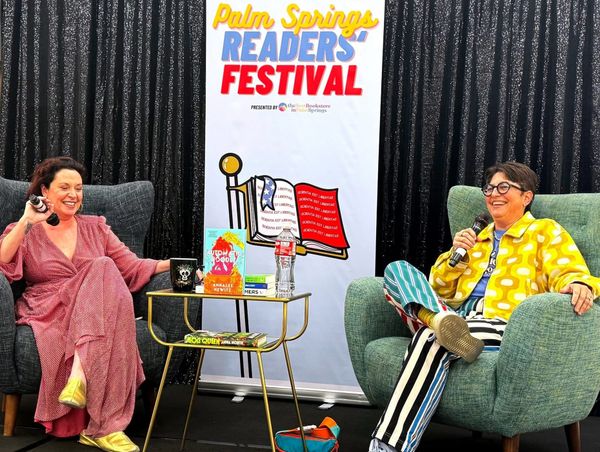
Chris Pavone moved furniture for us and fetched me a drink at our Palm Springs Festival.
Louise Penny just rolled into our Palm Springs store one day, said, "Hi, I'm Louise," and signed books, and asked Paul if she could be helpful in his career.
That's because being a writer is SO DAMN HARD YOU NEVER GET TO BE A PRIMA DONNA. YOU HAVE TO REMAIN ADAPTABLE. ALWAYS.
Point 4.2: Storytelling is everything.
On the other hand, anyone who can tell a story can make money for life. The idea that that's an unadaptable skill is absurd.
It is why we survived. It is why our ancestors didn't get eaten by lions.
Storytelling is how you sell. Storytelling is how you fundraise. Storytelling is how you win a campaign. Storytelling is how you win a war. Storytelling is how you take a company public.
EVERYTHING in life, love, media, art, and -- yes-- capitalism is storytelling.
As I recently wrote, the masters of AI and the largest venture funds on earth are all hiring storytellers for as much as $700k in salary, because they know this.
Oh, bless your heart, Washington Post that you don't know that. The reason we all even care about the Washington Post is because of the STORY of Watergate. Your rep is still literally dining out on that. I don't mean that in a negative way. There are still a lot of excellent journalists there.
But there are a lot of excellent journalists at a lot of daily papers not are not considered one of the two great daily papers in the country.